
Or call (480) 448-8890
Fall is the best planting window in Scottsdale — the heat breaks, and vegetables, flowers, and desert natives that would burn up in July all get a real shot at establishing before next summer. But every plant on this list has a different relationship with water, and most irrigation problems we see in the fall aren’t about whether people water their new plantings — they’re about watering everything on the same schedule when it shouldn’t be.
✅ Licensed & Insured | ✅ 5-Star Rated | ✅ Free Estimates | ✅ Family-Owned
Best Fall Vegetables to Plant in Scottsdale
Here’s what to protect, and how.
- Tomatoes — consistent, deep watering; let the top inch of soil dry between waterings rather than keeping it constantly wet, which invites root rot.
- Lettuce — shallow roots need frequent, light watering to keep the top few inches of soil evenly moist.
- Carrots — steady, even moisture while roots develop; inconsistent watering is the most common cause of split or misshapen roots.
- Broccoli — deep, regular watering; letting the soil dry out fully tends to push it toward early bolting.
- Kale — moderate, consistent moisture; more forgiving than lettuce but still suffers in fully dried-out soil.
- Spinach — frequent light watering, similar to lettuce, since it’s shallow-rooted and bolts quickly under moisture stress.
- Onions — steady moisture while bulbs are forming, tapering off as they mature.
- Radishes — quick-growing and shallow-rooted; consistent light watering produces the best texture and prevents a sharp, woody bite.
- Beets — even moisture throughout; drying out and rewetting cycles are a common cause of tough, fibrous roots.
Best Fall Flowers for Scottsdale
- Pansies — regular moisture, especially while establishing; they don’t tolerate fully drying out but also don’t want to sit wet.
- Violas — similar to pansies, consistent light watering rather than deep infrequent soaks.
- Snapdragons — moderate, even watering; better drought tolerance once established than pansies or violas.
- Petunias — regular watering while young, tapering as roots establish; wilting is usually the first visible sign they’ve gone too long between waterings.
- Calendula — moderate water needs; more drought-tolerant than most fall annuals once established.
- Alyssum — light, consistent moisture; shallow roots mean it dries out fast in full sun.
- Dianthus — moderate watering with good drainage; more prone to problems from overwatering than underwatering.
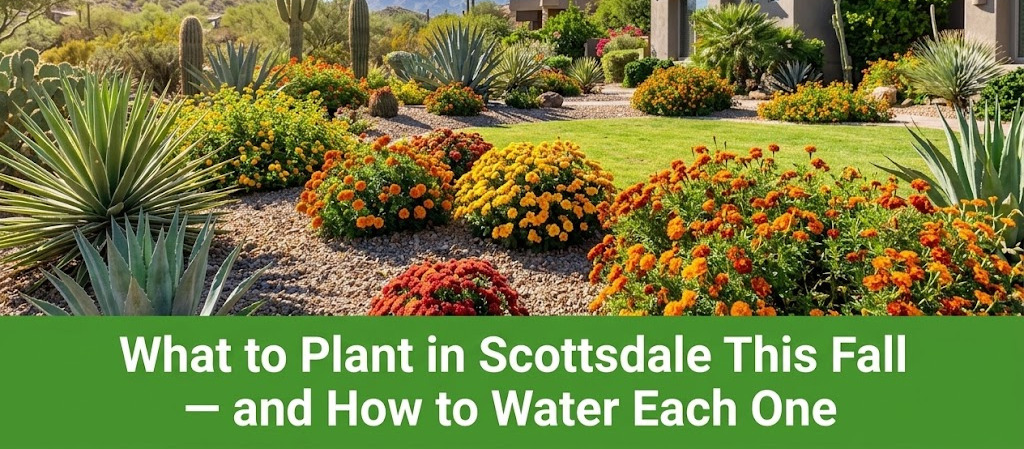
Best Low-Water Plants for Scottsdale
- Agave — minimal supplemental water once established; deep, very infrequent watering during establishment, then largely rainfall-dependent.
- Aloe vera — infrequent, deep watering; more likely to suffer from too much water than too little.
- Red yucca — very low water once established; occasional deep watering is enough even through a dry winter.
- Lantana — low water once established, though appreciates a bit more consistency than agave or yucca during its first year.
- Texas sage — thrives on minimal water; overwatering is a far more common problem than underwatering.
- Fairy duster — low water, drought-adapted; established plants can often rely on natural rainfall alone.
- Desert marigold — low water and short-lived by nature; light, infrequent watering is enough to keep it going through its bloom cycle.
- Penstemon — low-to-moderate water; slightly more moisture-dependent than the true desert natives on this list but still needs infrequent, deep watering rather than frequent light watering.
The Pattern Across All Three Groups
Vegetables and flowers generally want frequent, shallow moisture while they’re establishing, and low-water desert plants want the opposite — infrequent, deep watering, even during establishment. Putting a new vegetable bed and a new agave planting on the same drip schedule is one of the most common ways a fall planting underperforms, and it’s an easy fix once the zones are separated correctly on the controller.
What’s Included in the Free Zone review
- A look at your current zone setup against what’s actually planted in each one
- Flagging any zones mixing high-water and low-water plants on the same schedule
- Straightforward recommendation — split zones if needed, or confirm your setup already works
Or call (480) 448-8890
Frequently Asked Questions
Can I really mix vegetables and desert plants on the same drip line?
Not ideally — vegetables generally want frequent, shallow watering while desert natives want infrequent, deep watering. Mixing them on one zone means one of the two is getting watered wrong.
When’s the best time to plant these in Scottsdale?
Fall, once the heat breaks — it gives vegetables, flowers, and desert natives time to establish before next summer’s heat.
Do I need a new zone every time I add a different type of plant?
Not necessarily — but if you’re planting several different types at once, it’s worth having zones reviewed to make sure the schedule matches what’s actually in the ground.
If you’re planting several of these at once across different parts of your yard, that’s usually a good moment to have your zones reviewed — not because anything’s broken, but because a new planting is the easiest time to get the watering setup right from the start.
About Conserva Irrigation of Greater Scottsdale
Conserva Irrigation of Greater Scottsdale was founded on a simple mission: help Arizona homeowners use water responsibly without sacrificing beautiful landscapes — or family budgets. Toro and Hunter certified installation partners with 50+ 5-star reviews. Licensed, insured, family-owned. We serve Scottsdale, Glendale, Tempe, Chandler, Gilbert, and Phoenix.
(480) 448-8890 | conservairrigationofgreaterscottsdale.com